Sometimes memory needs a little music.
Hear this page.
Sometimes you may not feel like working on your book. That is okay. The Radio Room is here when you simply want to listen to some music, relax, and spend a little time with your companion. The music plays on your own machine — the room hands you the door, and then it listens with you. A song may remind you of someone, somewhere you served, a road trip, a dance, or nothing at all. You never have to turn that memory into part of your book unless you want to. Sometimes we write. Sometimes we remember. Sometimes we just listen.
Two shelves, one honest rule: the room itself never plays sound. It hands you the door, and then it listens while you remember.
Sometimes memory needs a little music.
Hear about the Dayroom.
Sometimes memory needs a little music. A song can bring back a place. Every good dayroom has a radio in the corner, and this one does too. The room itself never plays sound. Nothing plays inside these walls, nothing loads from outside them, we keep nothing, and we track nothing. Sometimes one song brings back an entire chapter.
A song can bring back a place. A voice. A year. A dance. A deployment. A person you have not thought about in decades. Every good dayroom has a radio in the corner, and this one does too: start the morning with familiar music, drink coffee, sit back, listen, remember — and talk whenever you feel like it. This should feel like home, not an appointment.
The room itself never plays sound. It hands you the door and then listens while you remember. Every door below leads out of our house, to free public collections kept by other people, and opens in a new window. Nothing plays inside these walls, nothing loads from outside them, we keep nothing, and we track nothing.
- Old Time Radio at the Internet Archive (opens in a new window)
Thousands of original broadcasts, free — the dramas, the comedies, the westerns, the news as it aired.
- Radio Programs at the Internet Archive (opens in a new window)
A second long shelf of programs from radio’s great decades.
- The 78rpm Records & Cylinder Recordings collection (opens in a new window)
The records themselves — big band, swing, the crooners — digitized from the original shellac.
- The George Blood 78rpm collection (opens in a new window)
Hundreds of thousands of sides, preserved one turntable at a time.
- Radio Garden (opens in a new window)
A globe you can spin: live stations from every country, free. Tune the town where you were stationed and hear it tonight.
- Old time radio shows, full episodes (opens in a new window)
A search of YouTube’s free public uploads — the long programs, good for a whole afternoon.
- Big band radio broadcasts (opens in a new window)
The ballroom sound, exactly as it went out over the air.
- Classic baseball radio broadcasts (opens in a new window)
The crack of the bat and the announcer who called it.
- Vintage variety shows (opens in a new window)
The Saturday-night television of its day, an episode at a time.
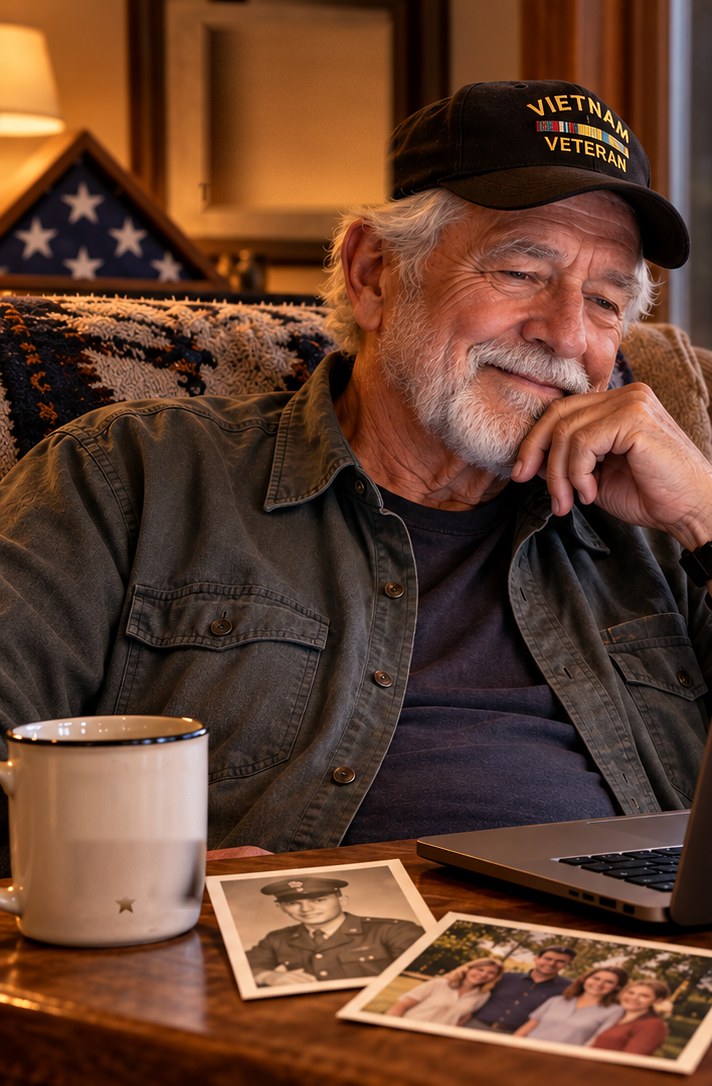
Music, one tap away, on what you already have.
Hear about the Quiet Hour.
Music, one tap away, on what you already have. A song can bring back a place, a voice, a year, a person you have not thought about in a very long time. The room does not play sound. Nothing here has to be typed. This room never plays music itself. Three keys, one memory — that is often exactly where a chapter begins.
The Quiet Hour is for something playing in the background while you sit, and drink your coffee, and remember at your own speed. The room does not play sound. The music plays on your own machine, in the player you already have — whatever came with your phone or computer, the app you already pay for, or a station on the web — and the room talks about the song with you while it plays. You can start it by voice if that is easier: tell your phone or your computer to play the song or the station, and it will. Nothing here has to be typed.
This shelf goes up one station at a time, and only after every link on it has been opened and proved.
- SomaFM — "We're a listener-supported, commercial-free internet-only radio station"
- Apple Music — the veteran's own Apple Music app or the web player.
- Spotify — the veteran's own Spotify account, free tier or paid.
- Radio Paradise (opens their own site) — describes itself as "an eclectic musical adventure"
- WWOZ New Orleans (90.7 FM) (opens their own site) — a listener-supported New Orleans community station; its player page bills itself
- KEXP (Seattle) (opens their own site) — a listener-supported public station with a live stream and archives.
- NPR member station streams (opens their own site) — the directory of local public radio stations, most of which stream free.
- The Internet Archive — Great 78 Project (opens their own site) — "a community project for the preservation, research and discovery of 78rpm records";
Every link opens on your own device, in the app or site you already have. This room never plays music itself.
Tell the room a year, put the music from it on, and open the photograph from the same season. A year, a song, a photograph — three keys, one memory — that is often exactly where a chapter begins.
Begin
Not sure what to do here? Questions about this room.
Here are the short answers. Inside the room — at the door on this site — you can ask your companion any of these too: type it, or let your device’s own dictation type it for you, and the answer is read aloud to you.
What do I do here?
Pick a door on this page and the music opens on your own machine, in a new window. Sit back, listen, and talk if a memory comes up. You do not have to work on your book here.
Does the room play the music?
No. It hands you the door; the music plays in your own player or a station on the web. Inside the room, tell your companion what you put on and it listens with you.
Can I just listen and say nothing?
Yes. Music and nothing at all is a whole visit.
A song brought something back. What now?
Tell your companion. If you want it in your book, say “put that in my book.” If not, it stays a conversation.
How do I go back?
The menu at the top takes you to any room. Inside the room, just say what you want to do next.